On September 24, 2026, unreleased configuration strings surfaced in OpenAI client code. The discovery points to an unannounced subscription tier named ChatGPT Pro Max priced at $500 / month.
The finding arrived just five days ahead of OpenAI DevDay on September 29, 2026. It lands two weeks after OpenAI paused new sign-ups for its $200 / month Pro tier.

The core value proposition listed in the leak is concise: “Fastest Work and Codex.”
This prompts an immediate question for builders: will OpenAI continue to offer the best value for subscription dollars, and what could a 50 x capacity tier actually deliver?
Evaluating this leak requires analyzing hardware architecture, wafer-scale economics, and shifting subscription margins.
1. Fact-Checking the Leak: What Was Actually Discovered
The leak was identified by reverse-engineer Tibor Blaho (@btibor91 on X) and reported by TestingCatalog.
Blaho shared captured screenshots and TestingCatalog published video demonstrations of unreleased checkout flows in the ChatGPT web client.
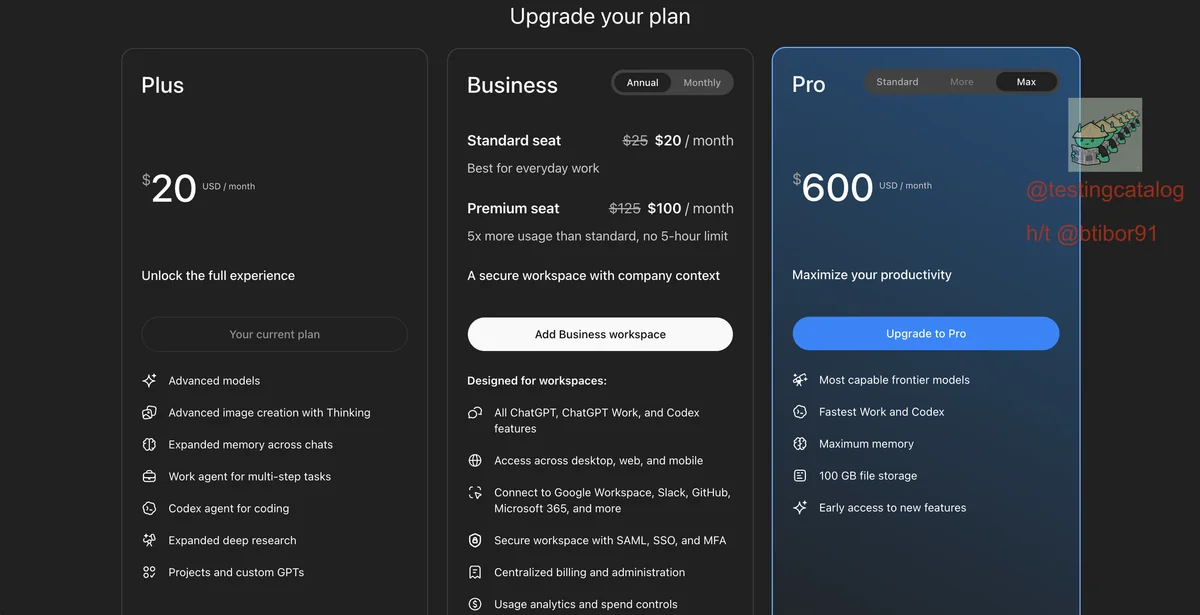
The client artifacts reveal several verifiable facts:
- Explicit Plan Identifier: The internal subscription
configuration references
promaxandchatgptpromaxproduct tokens in client artifacts. - Pricing Structure: The base plan price is set to $500 / month. In European locales with Value Added Tax (VAT), TestingCatalog notes the checkout video rendered at $600 / month.
- Dedicated Copywriting: The plan description specifically highlights “Fastest Work and Codex,” diverging from the reasoning and model-access copy of existing Pro tiers.
- Current Deployment State: Pro Max is currently unreleased staging code. OpenAI’s public catalog lists Free, Go, Plus ($20 / mo), and Pro ($100 / mo for 5 x headroom, per OpenAI support documentation). The $200 / mo Pro plan (20 x headroom) was temporarily paused for new purchases on September 10, 2026 due to high system load, with existing subscriptions continuing to renew.
The pause reflects broader infrastructure demand as compute-intensive reasoning models surged in popularity.
Video Proof, Up to $2,000 Deliberations, and the Cerebras Paradox (@chetaslua)
Following the initial strings report, AI researcher Chetaslua published direct video proof of the live subscription modal on X (@chetaslua on X).
The video demonstrates the exact client transition. It confirms that the single feature line that changes on the Pro Max tier is “Fastest Work and Codex”.
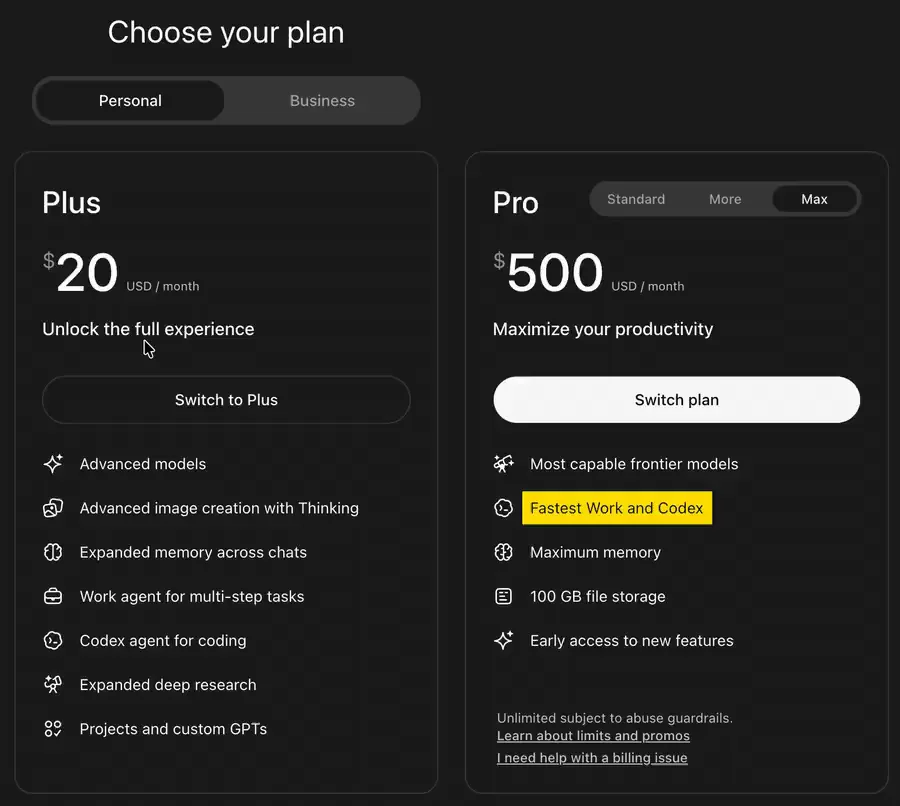
Chetaslua’s reporting added two critical nuances to community discussion:
- The $2,000 / Month Pricing Deliberation: Chetaslua noted that OpenAI had contemplated high-end tiers scaling as high as $2,000 / month. The unannounced checkout leaks suggest settling on $500 / month as a more practical ceiling.
- The Cerebras Cost Paradox: Chetaslua highlighted an architectural puzzle: Cerebras claims its wafer-scale architecture is 21 x faster at 1/3 the hardware cost of an NVIDIA B200. If wafer-scale silicon is cheaper to deploy per token, pricing Pro Max at $500 / month suggests OpenAI is either capturing premium software margins or bundling dedicated wafer reservations.
The Race for “Work”: Open Developer Posture vs. Walled Gardens
The leaked copywriting specifically joins “Fastest Work and Codex.” While Codex addresses autonomous terminal coding, “Work” represents OpenAI’s persistent workspace, canvas, and project execution interface.
OpenAI faces intensifying ecosystem competition for builder mindshare. xAI’s Grok Bot provides persistent terminal execution, while tools like Claude Code deliver deep contextual collaboration.
Crucially, OpenAI differs from competitors in its authentication posture. Anthropic and Google forbid routing consumer subscriptions into third-party harnesses, confining users to closed first-party web interfaces.
In contrast, OpenAI openly permits developer authentication across external CLI tools, IDE extensions (such as Cursor and Cline), and headless agent harnesses. The $500 plan is therefore not designed to build an anti-competitive walled garden.
Instead, pairing Work with wafer-scale inference delivers extreme velocity across both native interfaces and external Codex agent loops. Instantaneous execution keeps developers in an unbroken flow state while establishing a sustainable economic foundation.
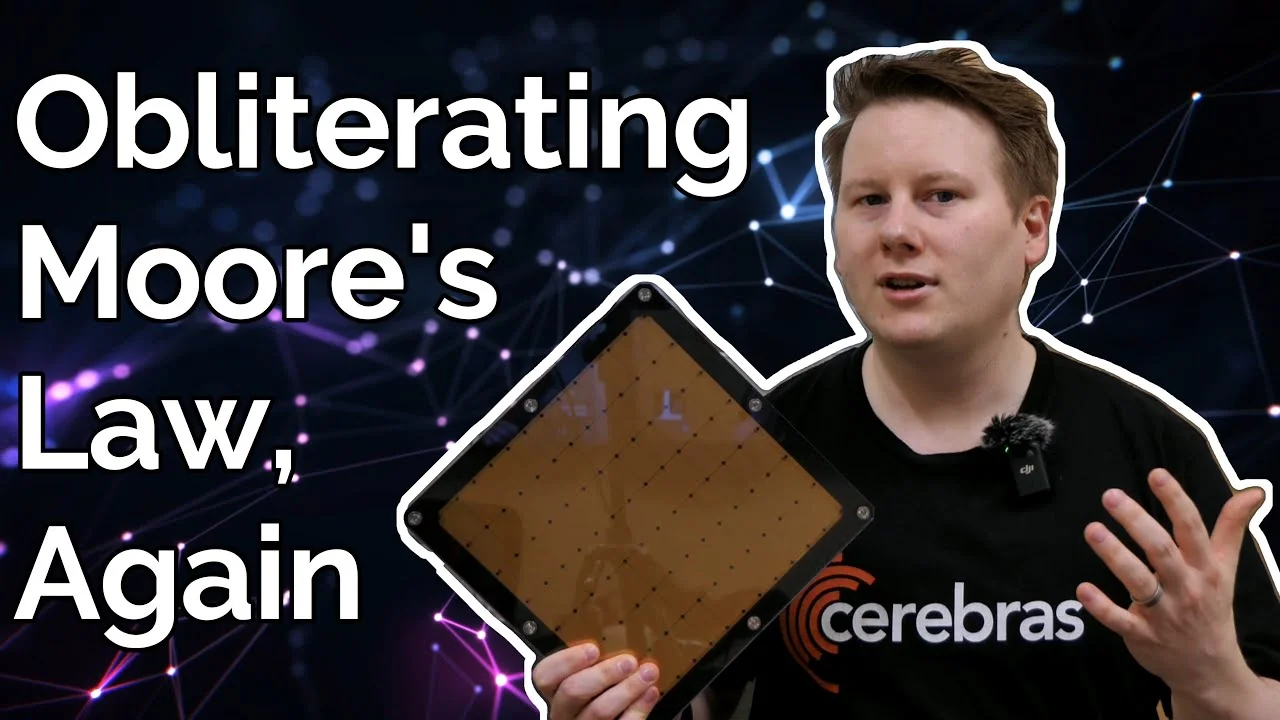
2. The Hardware Link: Cerebras Wafer-Scale Inference
Why does the leaked plan promise “Fastest Work and Codex” rather than higher message counts? The answer points toward specialized low-latency inference hardware.
In August 2026, OpenAI previewed GPT-5.6 Sol Ultrafast powered by Cerebras wafer-scale infrastructure, as reported by TestingCatalog on X. That preview demonstrated up to a 14 x inference speedup on latency-critical workloads.
Cerebras has also recently unveiled its rack-scale CS-4 system powered by WSE-3 Turbo chips, claiming up to 30 x faster generation over GPU baselines depending on model and workload configuration.
Earlier live testing dates back to late 2025 and early 2026, when
reports surfaced that OpenAI evaluated Cerebras CS-3 systems for
low-latency inference. Subscribers also noted that OpenAI recently
removed 5.3-codex-spark from standard subscription plans –
the exact model variant that served as the live wafer-scale test
previously bundled into subscriptions. Gating wafer-scale execution
behind an unannounced $500 / mo Pro Max plan indicates that OpenAI is
consolidating its low-latency silicon into a dedicated premium tier.
Standard GPU clusters (like NVIDIA H100 systems) excel at high-batch throughput. They process hundreds of concurrent user prompts efficiently in parallel.
However, single-stream sequential generation on standard GPUs is bottlenecked by memory bandwidth. Generating reasoning tokens sequentially requires fetching model weights from off-chip high-bandwidth memory hundreds of times.
+-------------------------------------------------------------------------------+
| INFERENCE SILICON ARCHITECTURE COMPARISON                                     |
+----------------------+---------------------------+----------------------------+
| METRIC               | NVIDIA H100 SXM (BASELINE)| CEREBRAS CS-3 (WSE-3)      |
+----------------------+---------------------------+----------------------------+
| Die Architecture     | Modular Multi-Chip GPU    | Single Wafer-Scale Engine  |
| Silicon Area         | ~814 mm² per GPU          | 46,225 mm² (Full Wafer)    |
| AI Compute Cores     | ~16,896 CUDA / Tensor     | 900,000 AI Cores           |
| On-Chip SRAM Cache   | ~50 MB per GPU            | 44 GB On-Wafer SRAM        |
| Memory Bandwidth     | ~3.35 TB / s HBM3         | 21 PB / s Unified SRAM     |
| Generation Speed     | 60--120 tokens/s          | 1,000--1,800 tokens/s      |
| Execution Latency    | Baseline (1.0 x)          | Up to 14 x Faster          |
+----------------------+---------------------------+----------------------------+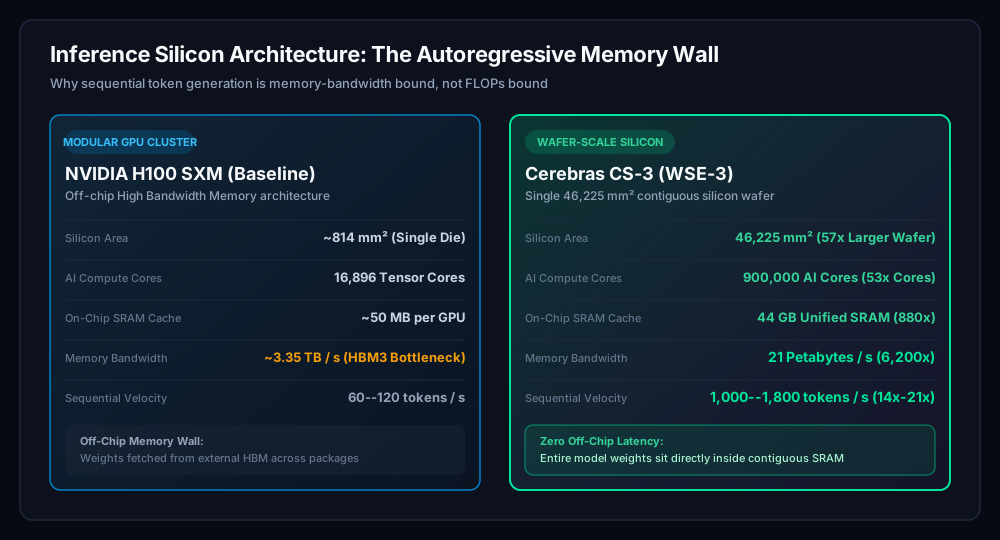
The Cerebras CS-3 Wafer Scale Engine-3 (WSE-3) eliminates this off-chip memory bottleneck. It integrates 44 GB of SRAM directly on a single contiguous 46,225 mm² silicon wafer with 21 PB / s of bandwidth.
Entire model layers reside directly on-chip. Tokens generate without waiting for off-wafer memory transfers. Observed inference speed improvements vary depending on workload, configuration, and model architecture.
Why Speed Matters for Codex and Work (But Not for Chat)
For conversational chat, 1,000 tokens/s is largely wasted. Humans read at roughly 5 to 8 words per second. Reading speed cannot absorb thousand-token bursts in real time.
For autonomous agentic coding, inference velocity changes everything:
- Autonomous Refactoring Loops: An agent using Codex does not just output text. It writes code, invokes terminal tools, runs test suites, and repairs syntax errors. Non-trivial refactors span 20 to 50+ agent steps and dozens of tool calls.
- Compressing the Feedback Loop: When an agent runs on standard GPU clusters at 30 to 60 tokens/s, a multi-file refactor takes 20 to 35 minutes. Developers context-switch, lose working memory, or step away from their keyboards.
- The Wafer Acceleration: On wafer-scale silicon generating 1,000+ tokens/s, that exact agent loop finishes in under two minutes.
- Developer Value: Instantaneous execution keeps engineers in an unbroken flow state. For an engineer billing $150 / hr, saving 15 hours per month in waiting time delivers $2,250 in billable value. That easily offsets a $500 monthly fee.
Speed is the primary commodity for autonomous agent workflows.
Dual-Bucket Architecture: Dedicated Hardware Lanes
Developers have long noted that OpenAI can partition dedicated fast lanes for terminal tool execution, keeping low-latency interactive loops isolated from standard heavy reasoning quotas.
This operational split assigns hardware pools based on workload bottlenecks:
- Wafer-Scale Pool (Cerebras): Dedicated to ultrafast deep research, interactive architectural planning, and real-time coding, where high streaming velocity keeps the human developer in flow.
- Standard GPU Pool (NVIDIA): Dedicated to background subagent swarms, scheduled tasks, and execution loops with long serialized tests or slow network tool calls, where token velocity is secondary to I/O latency.
Partitioning wafer-scale capacity from general GPU cluster pools is an established architectural strategy that optimizes both user velocity and compute costs.
3. The Economic Context: Token Economics and the Capacity Frontier
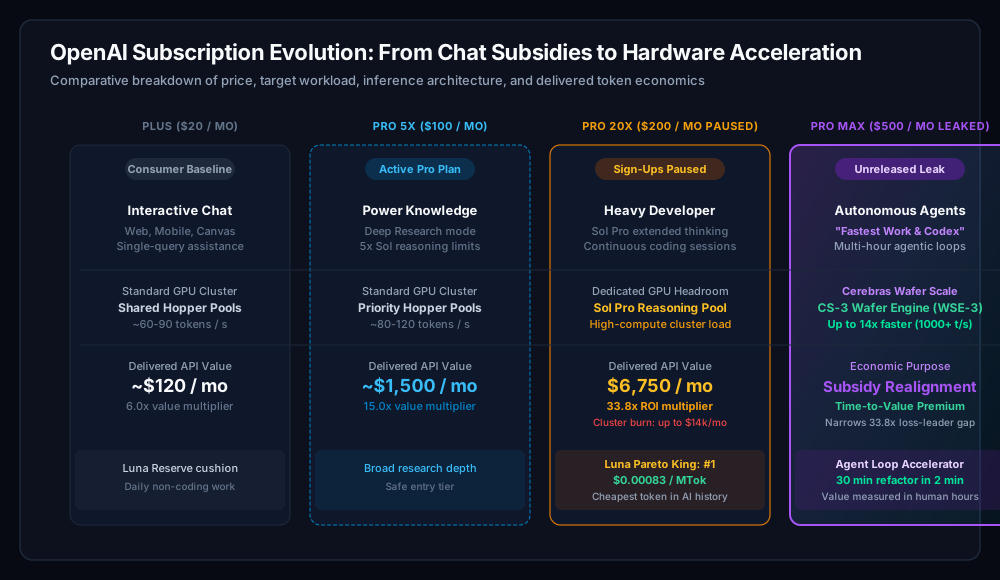
To evaluate a $500 plan, consider the delivered economics of existing subscriptions.
Our analysis of LLM Subscription Token Value and ROI examined empirical benchmarks published by researcher Kun Chen (@kunchenguid on X).
Chen’s saturation tests estimated that high-tier $200 / month developer plans deliver roughly $6,750 to $7,200 / month in API-equivalent token value (33.8x to 36.0x ROI multiplier over list price) [Source: Kun Chen empirical audit].
Hardware cost modeling by industry analysts suggests continuous multi-turn reasoning sessions incur thousands of dollars in underlying GPU cluster compute, creating deep operational deficits when subscriptions are fully saturated.
+-------------------------------------------------------------------------------+
| DELIVERED VALUE VS. SUBSCRIPTION PRICE (EMPIRICAL AUDIT)                      |
+--------------------+-----------------+--------------------+-------------------+
| SUBSCRIPTION PLAN  | MONTHLY PRICE   | DELIVERED API VALUE| VALUE MULTIPLIER  |
+--------------------+-----------------+--------------------+-------------------+
| SuperGrok Heavy    | $300 / mo       | $12,000 / mo       | 40.0x ROI         |
| Claude Max         | $200 / mo       | $7,200 / mo        | 36.0x ROI         |
| ChatGPT Pro (20X)  | $200 / mo       | $6,750 / mo        | 33.8x ROI         |
| Cursor Ultra       | $200 / mo       | $3,400 / mo        | 17.0x ROI         |
+--------------------+-----------------+--------------------+-------------------+
Ranked Unit Cost: Luna Saturated Economics
In research conducted by FeiZ (@Fei2411 on X) in real-api-pricing, GPT-5.6 Luna on ChatGPT Pro 20X sits among the cheapest measured points. It delivers compute at an effective unit price of $0.00142 per Million Tokens ($0.00142 / MTok). Earlier drafts cited $0.00083 / MTok and a 240.2 billion token monthly figure. FeiZ’s current adopted table supersedes both, because the 240.24 billion token figure came from a Sol-credit derivation that he has since replaced with a ChatGPT Plus dashboard measurement scaled to the higher tiers.
FeiZ measured the effective unit cost by dividing subscription fees by empirical saturated token throughput over four weeks:
Effective Unit Price ($/MTok) = Monthly Subscription Price ÷ Saturated Monthly Delivered Tokens
FeiZ’s adopted baseline puts Luna on the $200 Pro 20X plan at 141.163 Billion tokens / month at medium confidence [Source: FeiZ adopted table], fetched 2026-09-30. The figure is a scaled estimate rather than a direct saturation test, so treat it as evidence for a measurement period rather than a contractual ceiling.
This volume helps explain why OpenAI paused $200 sign-ups for new users. Developers routing terminal agents into unlimited tiers extracted billions of tokens monthly, straining cluster margins.
GPT-6 Serving Cost Optimization: Shifting the Pareto Curve Left
With the release of GPT-6 (Sol and Luna), OpenAI shifted its optimization priority from marginal benchmark gains to aggressive serving cost reduction.
Official OpenAI evaluations show both Luna and Sol moving decisively leftward on the Pareto frontier.
On FrontierCode 1.1, GPT-6 Luna and Sol delivered comparable or superior coding performance while dramatically reducing cost per task.
Similarly, on AutomationBench 1.0.6 across 47 tool evaluations, GPT-6 reduced the computational cost of tool-calling agent loops.
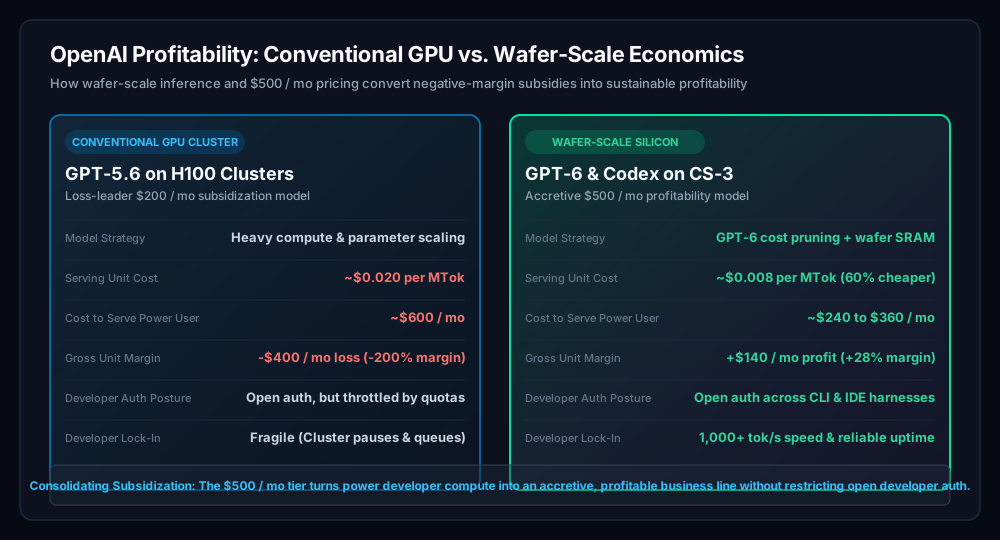
By cutting the underlying unit cost of inference, OpenAI creates room to sustain higher token allocations while steering subscriptions toward profitability.
<img src="/assets/articles/openai-chatgpt-pro-max-500-month-codex-cerebras/openai-gpt6-vs-gpt56-pareto-frontiercode.png" alt="Benchmark chart of FrontierCode 1.1 showing GPT-6 Luna and Sol shifting leftward on cost per task compared to GPT-5.6." width="600" height="400" style="width: 100%; height: auto; border-radius: 8px; box-shadow: 0 4px 15px rgba(0,0,0,0.3); display: block;" loading="lazy">
<img src="/assets/articles/openai-chatgpt-pro-max-500-month-codex-cerebras/openai-gpt6-vs-gpt56-pareto-automationbench.png" alt="Benchmark chart of AutomationBench 1.0.6 showing GPT-6 Luna and Sol achieving lower cost per task across 47 tool evaluations." width="600" height="400" style="width: 100%; height: auto; border-radius: 8px; box-shadow: 0 4px 15px rgba(0,0,0,0.3); display: block;" loading="lazy">Fifty-Fold Capacity Modeling: How Much Luna Does $500 Buy?
If OpenAI prices Pro Max at $500 / month, how could capacity scale?
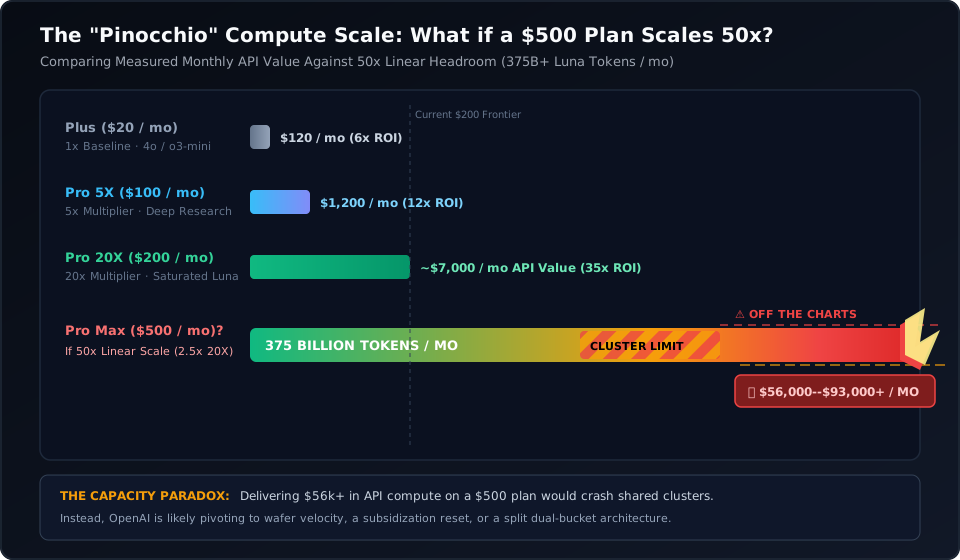
Examining the multiplier progression reveals why linear scaling is impossible: - ChatGPT Plus ($20 / mo) represents the baseline 1 x compute allocation. - ChatGPT Pro 5X ($100 / mo) delivers a 5 x compute headroom multiplier. - ChatGPT Pro 20X ($200 / mo) delivers a 20 x compute headroom multiplier.
If a $500 tier were to scale proportionally as a 50 x multiplier (2.5 times the 20X tier), what would happen? - Monthly Delivered Volume: Saturated Luna capacity would reach over 375 Billion tokens / month. - Daily Throughput: That represents over 12 Billion tokens generated daily for a single subscriber. - Delivered API Value: At standard developer API pricing ($0.15–$0.25 / MTok), 375 Billion tokens equals $56,000 to $93,000+ / month in equivalent compute.
Will OpenAI actually allow 375 Billion tokens on a $500 plan? The economics make that prospect virtually impossible.
Prompt Cache Pricing: What the Published Discount Does and Does Not Cover
Token capacity figures quoted above are measured allowances for a given plan, model, and measurement period. They are not contractual ceilings, and they are not altered by caching.
Cached prompt reads carry a published API price discount, up to 97.5 percent on Claude Fable 5.1 at $0.25 / M cached against $10.00 / M uncached. That discount is a price contract, so a higher cache hit rate lowers the metered API bill for the same volume of evaluated context. It is not a quota rule. No provider publishes how cached reads count against a consumer subscription quota, so this article does not claim any quota expansion from caching. Earlier drafts asserted a 10x to 40x expansion of effective context without exhausting rate limit pools. That claim is retracted because no source supports it. The repository it was attributed to states that its 97 percent cache-read mix is a comparison convention for dollar and credit pools, not a measurement of anyone’s real usage [Source: real-api-pricing conventions].
Whether a given subscription plan permits a volume of work is governed by its published session and weekly windows, not by cache hit rate. High cache reuse lowers your API cost per unit of work and is worth engineering for. It does not buy additional allowance.
The 20X Multiplier Reality: 5-Hour Session Windows vs. Weekly Account Caps
The nominal 20x branding across developer tiers also masks a profound architectural difference between OpenAI Codex and Anthropic Claude.
Anthropic documents the 20-fold multiplier as applying to per-session usage relative to Claude Pro, with the session allowance resetting every five hours [Source: Anthropic Max plan documentation]. A separate weekly usage limit applies across all models at a fixed assigned reset time.
The limit structure on both sides is similar, and the difference is smaller than marketing implies: - No Published Weekly Ratio: Anthropic does not publish a 20X-to-5X weekly ratio. Earlier drafts of this article cited a community estimate of roughly 1.7x to 2.0x over the Max 5X tier. That figure is unsourced and has been removed. - The Evaporating Session Window: If an engineer steps away, sleeps, or reviews pull requests, the unused 5-hour allowance evaporates. It cannot be banked or rolled over. - Codex Applies Both Windows Too: Codex on ChatGPT Plus and Pro plans carries a 5-hour allowance and a weekly allowance, and a purchased instant reset restores both while restarting the weekly clock. Codex therefore has no continuous entitlement that survives its five-hour window. - The Real Difference: Anthropic scopes its published multiplier to a session, whereas OpenAI documents a purchasable reset path. Both vendors apply a short window and a weekly cap.
4. Speculation: What Value Will a $500 / Month Plan Deliver?
With Luna delivering unprecedented token efficiency on $200 plans and cluster demand surging, why is OpenAI preparing a $500 tier? Developer speculation centers on four distinct structural hypotheses:
Hypothesis A: Proportional 50-Fold Value Scaling (Maintaining Value Per Dollar)
The most developer-friendly possibility is linear headroom scaling.
Under this model, Pro Max follows the established multiple progression. Plus represents baseline, Pro 5X ($100 / mo) delivers a 5 x multiplier, and Pro 20X ($200 / mo) delivers a 20 x multiplier.
Extending that slope to $500 / month yields a 50 x headroom multiplier (2.5 times the 20X tier).
What would 50 x capacity deliver under saturation according to empirical token modeling? - Delivered Monthly Volume: Saturated Luna usage would reach roughly 375 Billion tokens / month. - Daily Throughput: That equates to over 12 Billion tokens generated daily for a single subscriber. - Equivalent API Value: At standard developer API pricing ($0.15–$0.25 / MTok), 375 Billion tokens equals $56,000 to $93,000+ / month in raw compute value. - Unit Economics: Effective token costs remain at $0.00133 / MTok, preserving OpenAI’s standing for maximum value per subscription dollar.
However, physical datacenter capacity presents a severe obstacle. Delivering 50 x headroom to thousands of autonomous agent runners would risk destabilizing shared clusters.
Hypothesis B: The Subsidization Reset (Zero Additional Headroom or Price Replacement)
The opposite possibility is that OpenAI is actively reducing its subsidization deficit.
As revealed in empirical saturation audits, power users consume thousands of dollars in underlying GPU compute. On a $200 subscription, this represents a substantial operational deficit.
In this scenario, the $500 tier offers 0 x additional compute headroom over the previous 20X tier.
Instead, $500 / month becomes the new replacement price for the exact same 20 x compute allocation that previously cost $200.
Raising the price from $200 to $500 increases OpenAI’s direct subscription revenue by 150 percent while dampening cluster contention from unsustainable automated loops. Developers running commercial agent pipelines would pay the premium, while casual experimenters would step down to Pro 5X ($100 / mo).
This resets heavy power-user compute from a loss-leader deficit into an economically viable tier.
Hypothesis C: Pure Wafer Velocity (The Same 20X Allocation at 14-Fold Speed)
A third hypothesis decouples price from token count and ties it directly to inference velocity.
In this model, Pro Max subscribers receive the exact same 20 x quota as the paused $200 tier. However, the entire allocation routes through wafer-scale engines at low latency.
Subscribers pay the $300 premium strictly for developer velocity rather than larger token allocations: - Collapsing Agent Loops: Autonomous multi-file refactoring runs that take 35 minutes on standard GPU clusters finish in 2.5 minutes on wafer-scale silicon. - Zero-Latency Iteration: Code edits, linter checks, and test passes execute synchronously without context switching. - Billable Hour Economics: For a software engineer billing $150 / hr, eliminating 15 hours of idle waiting time per month recovers $2,250 in billable value.
For professional software teams, instantaneous execution velocity easily justifies the $500 monthly fee, even with zero additional token allocation.
Hypothesis D: The Dual-Bucket Execution Model (Separating Interactive Speed from Background Tasks)
The fourth hypothesis explores a split-quota architecture tailored to agent latency bottlenecks.
Under a dual-bucket structure, OpenAI could provide an aggregate 40 x headroom allocation divided across two distinct silicon pools: 1. 20 x Ultrafast Wafer-Scale Pool: Dedicated to deep research, interactive architectural planning, and real-time coding. Generating at 1,000+ tokens/s keeps the engineer in an unbroken flow state during live problem-solving. 2. 20 x Standard GPU Reasoning Pool: Dedicated to background subagent swarms, scheduled jobs, and execution loops with long serialized test runs or slow external tool/network I/O.
This architecture ensures high-speed wafer silicon is never idled while waiting for external network requests or local test suites.
Next-Gen “Work”: The Strategic Weapon for Autonomous Workflows
These hardware and pricing models directly power OpenAI’s evolving software interface.
The leaked Pro Max copywriting specifically highlights “Fastest Work and Codex.” While Codex addresses terminal execution, “Work” represents OpenAI’s persistent workspace, canvas, and project environment.
OpenAI faces aggressive competition for developer workflows: - xAI’s Grok Bot: SuperGrok provides persistent, multi-step autonomous agent execution inside user terminals. - Anthropic Claude Code: Claude Code workspaces deliver deep project-wide contextual collaboration and automated codebase maintenance.
Crucially, OpenAI’s strategy with Work and Codex relies on open integration rather than restrictive lock-in. Competitors like Anthropic and Google actively restrict subscription credentials to their first-party web clients.
In contrast, OpenAI embraces developer auth tokens inside third-party environments like Cursor, Aider, and headless terminal harnesses. By pairing open developer access with wafer-scale speed and persistent workspace memory, OpenAI protects its developer ecosystem without erecting an artificial walled garden.
5. Strategic Guide: How to Get Maximum Value Across AI Plans
Whether OpenAI launches Pro Max at DevDay or adjusts existing tiers, engineers must navigate quota mechanics deliberately.
Here is the operational playbook for maximizing token value today:
1. Leverage the Dual-Bucket Sandwich Architecture
Never burn expensive terminal agent reasoning tokens on ambiguous requirements.
As detailed in our Headless Terminal Agent Harnesses Guide, apply the three-step sandwich:
- Step 1 (Architecture & Pre-Planning): Use flat-rate web GPT Pro (or Claude Opus) to draft specifications, database schemas, and task decompositions. This draws from the flat-rate web subscription with zero marginal cost.
- Step 2 (Deterministic Execution): Feed the validated plan to lightweight coding agents running fast, cheap models in terminal harnesses, backed by deterministic AST checks and local regex guards.
- Step 3 (Post-Validation): Bring the finished pull request back to high-compute web models for adversarial verification.
2. Compare Against Competing Ecosystem Quotas
Before committing $500 monthly, audit the broader subscription landscape:
- Anthropic Claude Ecosystem: Our Claude Pro & Team Analysis covers Claude Code limits and the strict 5-hour rolling lockout window.
- Google AI & Jules: Our Google AI Studio and Jules Guide examines free 1 M token context windows and dedicated cloud development environments.
- Cross-Plan ROI Rankings: Review our Empirical Subscription ROI Audit for detailed cost-per-token curves across Cursor, Grok, and Claude.
The era of cheap, undifferentiated AI subscriptions is evolving into hardware-differentiated performance tiers. Monitoring where compute dollars yield real engineering velocity is essential.
As OpenAI prepares for its upcoming product announcements, the strategic direction is clear: velocity and sustainable unit economics are replacing raw, unconstrained token subsidies.
Will OpenAI introduce a Cerebras-powered $500 plan on September 28, or take a different path?